Much ink has been spilled on the state of Ontario’s auto-industry. The sector faces many challenges: High labour costs, tarriff drama, and electrification to name a few. That last one, even prompted Mr. Ford to encourage BC and Quebec to abandon their electrification goals (source). We believe Mr. Ford’s insistance on BC and Quebec to abandon their electrification goals is misguided, in fact it is more harmful to Ontario’s auto-sectors long term viability.
Lets start with the biggest problem facing Ontario’s auto industry: Economies of scale. How many vehicles do you need to push through your auto-plant in order to make a reasonable profit? The answer is somewhere between tens of thousand to hundreds of thousands (source). Suppose we were to implement the vision of “every car sold in Canada should be made in Canada” (source), well in 2025 we sold 2 M new vehicles in Canada, for the auto-industry numbers to work out, the Canadian market could support 20 models. A far cry from the hundreds or thousands currently on sale, just the list of EVs that qualify for the new federal incentive numbers 85 at the time of this writing, far too many models (source).
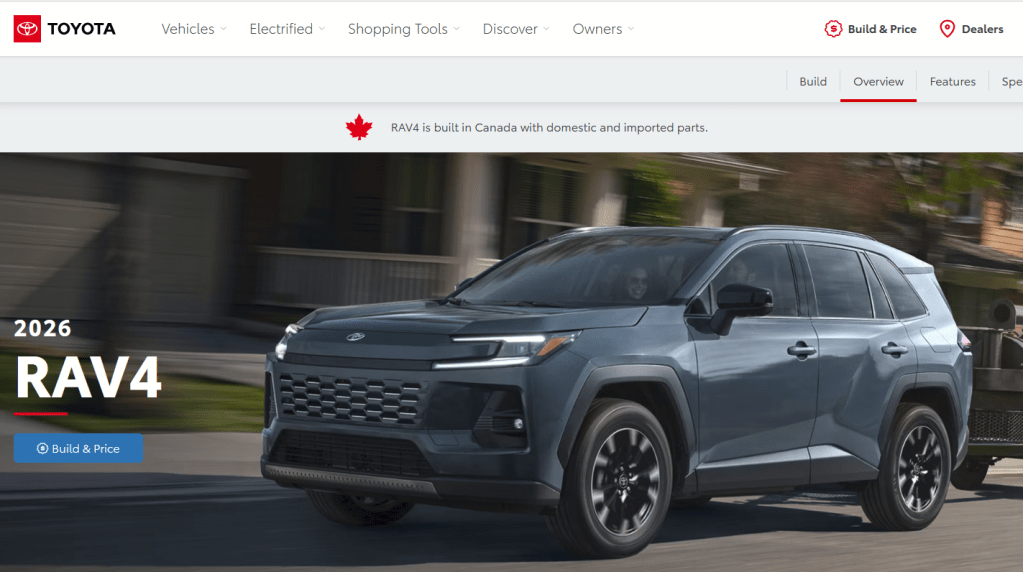
Looking at the top ten sellers in Canada, at the top of the list, the F-150 series, sold 140k units, the Toyota Rav 4 sold 75k units, and the Honda CRV at 56k units (source). Those three could support a Canadian line pumping out vehicles, exclusively for the Canadian market.
Thus the only way a Canadian based auto-manufacturing facility can make any sense is through exports. Since cars are big and heavy, there is really only one possible destination country, the United States. Enter Mr. Trump, who has put it seems Tarrifs on just about anything, including Canadian made vehicles of up to 25% (source). That’s enough thumbing on the scales to make profit difficult for Canadian based vehicle making. True, countermeasures are working, and Mr. Trump has had to backpedal on some of his Tarrifs (source, source).
Then there is Mexico. An auto-worker at a plant in Mexico might earn $6/hr, compared to perhaps ten times that in Canada (source). No wonder auto-manufacturing has boomed in Mexico, 80% of the new vehicle factories built in North America were built in Mexico (source).
How does Ontario’s auto-industry respond to this? Keep doing what were doing is not going to work, we need to leverage our strengths. Ontario produces high quality vehicles, has expertise in producing electric vehicles, and high labour costs. All of this fits very nicely with Electric Vehicles, which naturally command a premium. With the current administration in the US killing their EV industry (source), the oportunity for Ontario is clear.
Skate where the puck is going to be, not where it is, goes the mantra (source). Ford, GM, Stellantis have all announced plans to somewhat abandon their electrification plans, even go back to making big V8 truck engines (source, source). So, what happens when someone else enters the white-house, or some crisis errupts in the middle east that hikes fuel prices? Now is the time to spin up Ontario’s EV industry, and be ready when the US is ready for EVs.
We do not believe Ontario’s auto-industry is screwed. Yes there are short-term pains owning to US trade policy, but there is also a large oportunity in EV exports to the US as Ontario can and should take the lead.


One thought on “Is the Ontario Auto-industry screwed?”