Recently I became aware of “The Grizzle-E club” (source). It is organized by United Chargers, the EVSE manufacturer of the Grizzle-E charging staions. You can get a home charging station for as little as $100 (installation is extra), and earn up to 10c/kWh thereafter. Lets look at the economics of this, take a closer look at the terms and conditions.
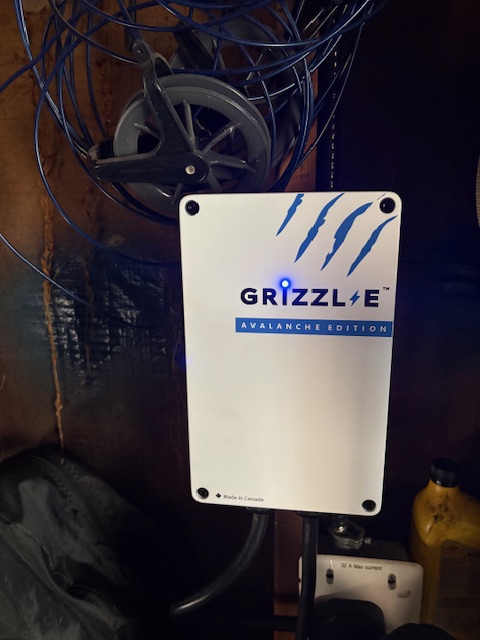
Suppose you found yourself in need of a home charging station, well now, its hard to beat the “The Grizzle-E club” (source). Get a charging station for as little as $100 (normal retail price is $499), then earn money as you charge, starting at 3c/kWh and going up to 10 c/kWh as you charge more. I originally got myself a Grizzle charger, mostly as they score well in reliability ratings, are Canadian based, offer hardwired settings for max current and came with a NEMA 14-50 plug. All that at a very reasonable price.
Lets take a closer look at the economics. The lowest power price one can get, is 7.2 c/kWh, on the ultralow overnight rate (adding the transmission charge, and HST see this post). You would need to be at Level 6 in The Grizzle-E club parlance (source), in order to earn more in credits than the cost of power, and thereby start earning something towards the $100 investment. You would get there after 20 MWh of charging, assuming 15 k km/year and 5 km/kWh average consumption, and doing all of your charging at home, why thats 6 years and 8 months of charging. Once you got there, you would be looking at 30$ – 100$ per year. But I am making the very far fetched assumption that power prices will remain the same after roughly 7 years, given infationary pressures, AI and whatnot, electricity is almost certain to go up.
What is paying for all of this? Apparnelty the Canadian Clean Fuel Regulations (source), which can under certain conditions, fund projects that reduce CO2 emissions, perhaps up to $350 per tonne of CO2 equivalent. 1L of gasoline generates 2.3 kG of CO2, assuming 8.9 l/100 km average Canada wide fuel economy (source and source), driving 1 km in a gas car produces 0.28 kG of CO2, assuming 5 km/kWh efficiency again, a kWh used to propell a car, would avoid 1.42 kG of CO2. If we use the full $350/tonne, each kWh used to propell a car, should be worth 50 cents, quite a bit more than the max 10c/kWh one individual might earn in the Grizzle-E club (source).
As with all things government, there is always a fair bit of paper, the cost of which easily burries any cost benefit one could hope to obtain. Bidding documents from the Canadian documents often stretch into hundreds and thousands of pages (source). Besides there are many conditions say an oil company would have to abide by in the Canadian Clean Fuel Regulations (source), all of this cuts into the rebate an individual might hope to obtain.
Given I already have a charger, I doubt that I will join. There is enough ambiguity in the Grizzle-E club terms and conditions (source), in particular around the ownership of the charging equipment to make me hessitant given the limited amount of money on the table.
Nevertheless we applaud United Chargers for creating the Grizzle-E club parlance (source), for someone looking to get a home charger, the club makes a lot of sense, spending only $100 to get a charger is quite the deal. The Grizzle-E club lowers barriers and makes home charging more accessible to all, a great thing. Take for example the rideshare driver, who could now benefit from reduced charging costs, go electric my friend.

