We have seen EV range steadily increase over the years, my new Kia EV4 now gets an astonishing official range rating of 552 km (source). Further, on the drawing board, are battery designs that could enable 1500 km range (source). Lets discuss the reasons for why more range might be better, despite the obvious cost issues. Also, how does this compare with combustion cars?
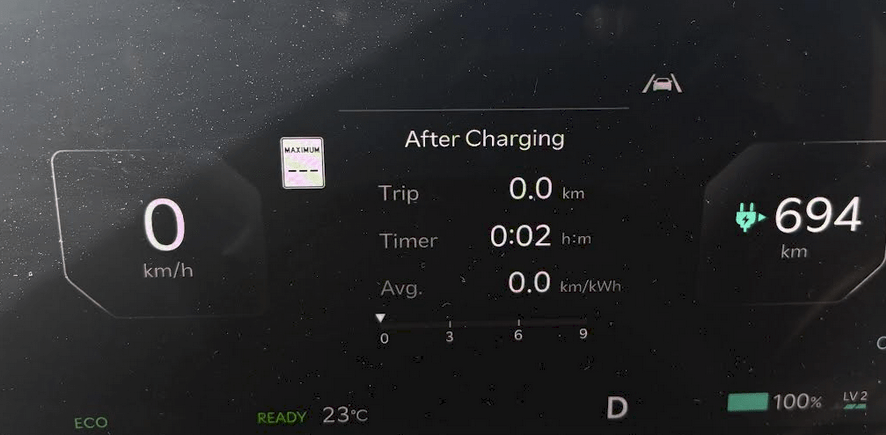
After charging up, my EV4 reported a whopping 694 km of range available. My goodness. I suppose this perhaps news to me, coming out of my 2018 Nissan Leaf, but we have had EVs on the market with 600+ km ranges for some time, the Lucid Air Grand Touring (824 km, source), Tesla Model S (660 km, source), the Rivians and Chevy Silverado (source) to name a few.
Time and time again, range is an important consideration for EV shoppers, and thus an important consideration to carmakers (source). “Range-anxiety”, the primal fear of running out of charge in the middle of the 401 say, and so on. Personally, I have a hard time imagining a need for such extreme range, after all my bladder is unlikely to last more than 250 km before I gotta go pee, and a little research can locate charging station that has washroom facilities, and perhaps some coffee/snacks/lunch/dinner etc. to go with it. In the 20 minutes the average user spends at a rest-stop, I might go from 10% to 60% charge (source). Usually I find my self stopping at familiar haunts, say Barrie, ON if going North, Bellville if going east, and Orangeville or London, ON if going West, thus I can usually recycle my research many times over.
Nevertheless, there certainly are parts of Ontario where charging is iffy (source). Indeed, I have had to slow-poke it on a road trip from Ivanhoe-Lake near Timmins,ON to Wawa Ontario (source). I made it, with plenty to spare, but those 694 km would have made for much happier kids. Then there is the extreme convenience of home-charging. No apps, queueing or stressing over broken chargers, home charging is in my opinion the most convenient there is. My mom has a charger at home and one at the cottage, and she more or less charges only at these two aforementioned locations.
Battery degradation and fast charging speed do greatly improve as the battery size gets larger. Cycle count (number of charge-discharge cycles), is an important indicator for degradation, the bigger the battery, the lower the cycle count for a given amount of usage, and thus less degradation (source). The “C-rate”, briefly charging speed relative to battery capacity, is a limiting factor when manufacturers set the max fast charging speed of their EVs, a bigger battery thus could charge faster, as it stays at the same C-rate compared to a smaller one (source).
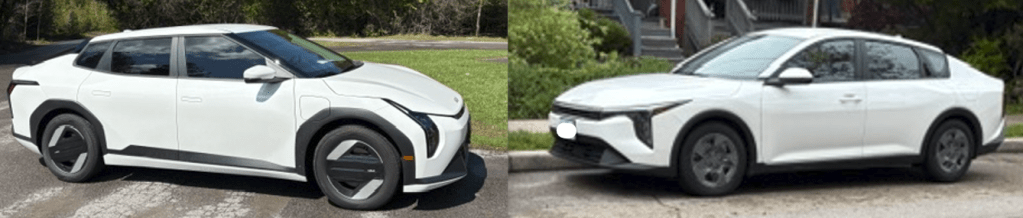
But how does 694 km compare to what we see in the combustion world? Well seems to be what the EV4’s combustion sibling manages. Looking at the specs for the 2026 Kia K4 (source), we note a fuel tank capacity of 47 l, and a combined fuel economy rating of 7.3 l/100 km, this gets us a “fully-charged” range of 644 km, less than what my EV4 thought I could do on a full charge. Doing the same math for the rest of the Kia combustion lineup gets similar numbers: Seltos, Sportage, Niro, Carnival, Sorento, and Telluride manage 657, 650, 954, 637, 712 and 607 kilometers respectively, 694 km first quite well in with Kia’s combustion offerings, save for the Kia Niro, hybrid’s 954 km.
Naturally comparing ranges is a tricky business, for all its flaws, the Environmental protection agency (EPA) at least has some standards that make these range figures somewhat comparable. I suspect the “combined” test has some mathematical trickery associated with it. On the EV side, I am not entirely sure I would manage the aforementioned 694 km on my EV4, although one youtuber got close (source).
Even so, few people have a gas station at home, but one might have a charging station, and everyone has at least an outlet. Hence charging an EV is much easier than charging a combustion car, and thus one could reason that the EV does not need as much range as a combustion car. Indeed this youtube video, drove a handful of EVs and a combustion car from London (England) to Edinburgh. The combustion car got perhaps 25% further than the longest legged EV, at 697 km. The fastback EV4 which I have, was not part of their test fleet, neither was the 824 km range Lucid Air grand touring (source).
Will the future bring EVs that have more range than gas cars? Perhaps, after all, home charging is very convenient. Much depends on what the market votes for with their wallets. If the EV4 Wind sales wind up unusually strong, Kia for example might choose to push range, despite the costs (source). The similarity of the Kia combustion line-up range figures is interesting, almost all fit between 600 and 700 kilometres, I guess in the combustion world that’s enough, even though using a larger fuel tank is much easier than using a bigger and a heavier battery. Hence, I doubt EVs will go much beyond that 600 km figure.
 Electric car adventures