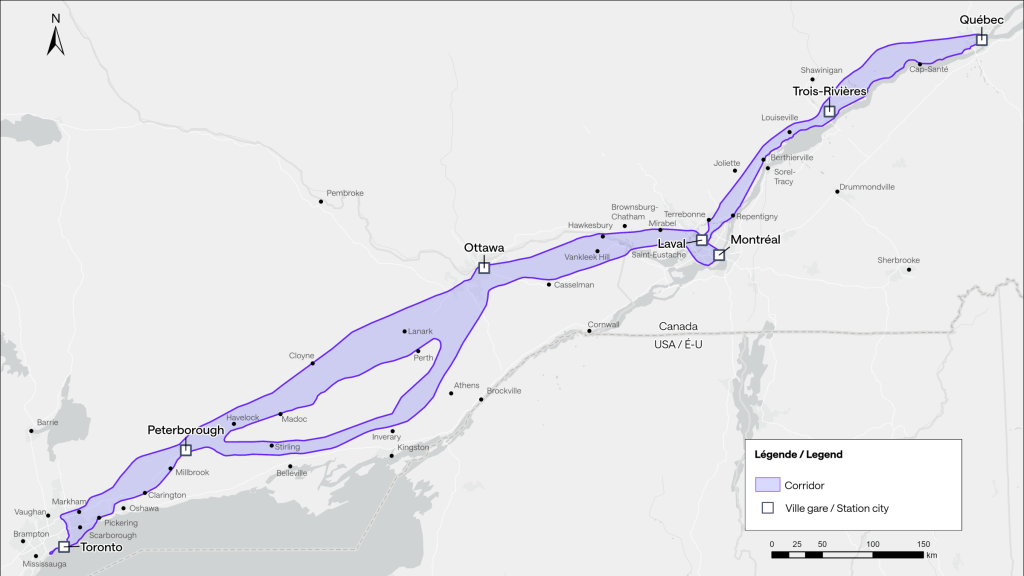
To much fanfare, the Alto consortium which aims to construct a high speed rail serving the Windsor-Toronto-Quebec City corridor, presented its plans. Briefly, the aim is to construct a rail line, roughly along the route: Windsor-London-Toronto-Peterborough-Kingston (kind of)-Ottawa-Montreal-Quebec City. Lets discuss, and see if this makes any sense.
Best to begin with why? After all, Alto is expected to cost tax-payers somewhere around 60-90 B$ (source). The answer lies in the estimated 1.1% of GDP growth, that might come from better connectivity between the communities along the route (source), and giving people a reliable, fast and a greener way to get to where they need to go. Alto might take some pressure of the 401, Pearson and other bits of congested infrastructure, which would need some taxpayer dollars if one were not to build Alto.
Take Toronto-Montreal for example, currently most people drive, about 75% of people drive, or take the bus, with the rest being split between air and rail (see table below). This is by itself interesting, as driving is by the looks of it, takes the longest of the three options I studied briefly. My neighbour for example, has taken many family trips to Montreal, usually driving, as their relatives live in the suburbs of Montreal, hence a car is quite handy once they reach the destination. To them, it was worth the extra two hours of round-trip travel time.

Then there are alternatives. More strategic upgrades to the via rail network, might result in travel times of say 4 hours (source), this would involve detailed work with whatever freight rail network owns the track, but speeds generally would top out at about 200 km/hr. This compares to 3 hours (source) on the 300 km/hr Alto. The cost of the more conventional 200 km/hr approach are difficult to pin down, but likely would be only a small fraction of Alto’s 60-90 B$ (source).
That four hour threshold for conventional rail, might prove quick enough. Data from Japan, suggests that if the train can make it in less than four hours, people tend to prefer the train, while if it is longer, people lean towards flying (source).
But Canada is not Japan, time is clearly not the critical factor when people ponder how to get themselves from Toronto to Montreal. Most drive, which is the longest option in my table. Thus perhaps people lean towards other things when deciding how to go between Toronto and Montreal, say cost or convenience, instead of speed.

