A buddy of mine asked me what the break even point is between gas and EV? This topic has come up before, I did respond that he might have a hard time filling up for a $2 (source), like I do every night. Also, a comparison between the Nissan Leaf and the Nissan Versa (source), where we discussed some of the nuances between Gas and EV re-fueling. But as the price of electricity and gasoline varies, as do the efficiencies of either your EV or Gas car. Lets dive in a little further and see how those two variables energy prices and efficiencies influence your situation.
As before, we look at the cost to drive a given distance, 100 km in our case. This is in my opinion fairer, than say the cost of just “filling up”, as vehicles come with “fuel-tanks” of all sizes and shapes, my 2018 Leaf can go at most 300 km under very ideal conditions, while a gas car with a spacious fuel tank might manage 600 km.
We then need efficiency statistics. Thankfully, our fall EV survey has EPA efficiency statistics (source), looking across the table, the average seems to be 6km/kWh, ranging from 4.5 km/kWh to 7.14 km/kWh. Fairly flat, but then again, range obsessed EV shoppers might nudge manufacturers to do their best to ensure efficiency. So, lets go with 6km/kWh efficiency.
Combustion wise, there is more fauna, the US average light duty vehicle (cars, SUV pickups etc.), was 26 miles to the gallon or 9 l/100 km in 2022 (source). EPA awards the Toyota Prius a 57 mpg (or 4.1 l/100 km), fuel efficiency rating, although some have apparently managed much better than that (source). Large thirsty trucks, sit at the other end of the spectrum, some versions of the F150 get 16 miles to the gallon (15 l/100 km) (source).
Next we need to assume energy prices. This can vary widely depending on where you live, your electricity tarrif and other things. Here in Ontario, I can get 5.5 c/kWh overnight, while a buddy in California might pay 73 c/kWh (source), albeit during peak hours once certain unlucky conditions are met, still at 30 c/kWh, California’s electricity prices are among the nations highest (source). Do note that some fast charging stations charge about that for that same kWh (source), lets set the range at 5 c/kWh up to 75 c/kWh.
Then there is gas, a sign at a nearby gas-station says 1.5 $/l, while someone might have to fork over $2/l in B.C. (source). The priciest gas in the states trophy goes to Hawaii at 4.5 $ US/Gallon which is about 1.7 $CAD/l, while the cheapest is in Oklahoma at 2.5 $ US/Gallon or about 1 $ CAD/l. Icelanders pay a whopping $3CAD/l for petrol (source), and so on and so forth. Thus our range is $1/l to $3/l.
Confused yet? Well, perhaps its time for some math. Lets start by comparing our average 6km/kWh EV (say the Nissan Leaf (source)), with an average gas car at 26 miles to the gallon (source). We compute the cost of driving 100 km in the EV and subtract the cost of the same 100 km drive in the gas-car. A big positive number, means that we spent a lot on electrons and not on gas, while a large negative number means we got cheap electrons, but spent heavily on gas. So lets colour the negative values green, as that means we spend more on gas than electrons, making the EV cheaper.
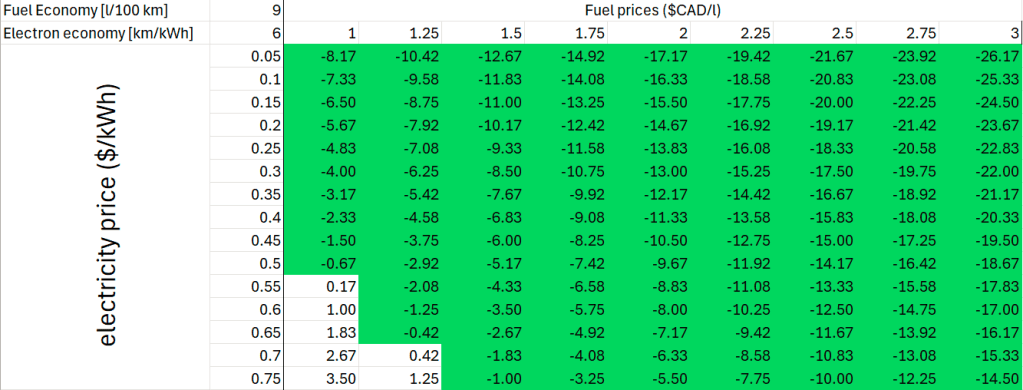
As we can see, large swaths of this table are green, thus under average conditions, EV is cheaper than the gas car, at least when charging at home at a reasonably affordable tariff. That said, at fast charging stations, gas may be much more competitive, and as we see, at 70c/kWh, the break even point is a little more than $1.25/l.
Then there is of course what efficiencies to use, and by extension which vehicles to consider. Its really tricky, the 2018 Nissan Leaf is a spacious family car, while the Tesla Model 3 can give a Lambo a run for its money on the track. A buddy of mine was tempted to compare the Tesla model Y to the Toyota Prius, which to me seem kinda silly, given that to me, the Y is more of a sporty family hauler (admittedly an odd combination), while the more compact Prius is more of an economical point A-B car with an eco tilt. Even a comparison between the Kia E-Niro and its gasoline powered cousin hits a snag. The E-Niro is sold as more of a premium vehicle, with a premium 45k price tag, bigger wheels and infotainment screen etc. (source, source).
That said, why not make your own cost comparisons. Below is a link to my spreadsheet, feel free to use it to explore your situation.
 Electric car adventures
2 thoughts on “Break even point, EV vs Gas?”