Lately, much discussion has swirled around building oil pipelines and increasing oil production. Articles with large numbers and the “tag-line” build oil pipelines now, preferrably to Prince Rupert, BC seem to be abundant. All suggesting that more oil production will bring Jobs and Money a plenty. But is oil really the land of milk and honey? Or are we saddeling future generations with what might be a massive cleanup bill making the whole thing the financial equivalent of a very expensive loan.
The first part of this, namely Jobs, is false. Yes it took tens of thousands of people to build the trans mountain pipeline (source), but once built, look to Hardisty Alberta, it takes 12 people to move 90 B$ (yes thats a B) of oil (source). It is incredibly efficient, if its jobs you want, the 34 B$ price-tag for some construciton jobs, seems awefully short sighted (source), now that construction is complete, Trans-mountain employ’s around 1000 people (source, and source), thats 34 Million public dollars per permanent employee. Jikes.
Second is money. This one is more nuanced. Oh yes, there is loads of money pouring out of the Oilsands, but as we will see, its more revenue than profit, if we include the cleanup, particularly if you want to clean up properly, there may actually not be a profit at all.
Lets start with the revenue side: It is true, the”bitumen royalty” is about 12% of the Province of Alberta’s revenues (source), also the 2025 annual report from say Suncor (a prominent company in the oil-sands, source), shows “profits” of about 10 % of revenue.
There is definitely money in oil. But is it enough? After all, there is a well known “liability-gap” in the industry (source). One of my buddies years ago worked as an auditor for a large oil-sands company, over drinks, I asked him how his former employer accounted for future cleanup and other liabilities, his answer: “They did not!”.
And there lies the problem, when the oil sands party ends, will the cleanup bill destroy the overall business case? Things such as abandoned wells (source), poisoned tailing ponds (source), and workers that need re-training (source) come to the forefront. History here is not on our side. A recent 2014 tailings pond breach in BC for example, was never fully cleaned up (source), people did what they could and felt was cost effective, but large quanties of very toxic slurry remain in the waterways of Polley lake and Quesnell lake, and will likely never be fully cleaned up. Regular water testing has so far not produced sufficient evidence to warrant what must be a very expensive cleanup of said slurry. Similarly residents of Grassy-Narrows are still feeling the after effects of a paper-mill upriver in Dryden, ON that dumped 9 tonnes of mercury into the waterways in the 1960s (source).
The scale of the destruction is staggering. Looking at google maps, satelite view, you can actually see it when the zoom level is set o to ALL of Alberta. 2trillion liters of contaminated tailings is a lot of water (source).
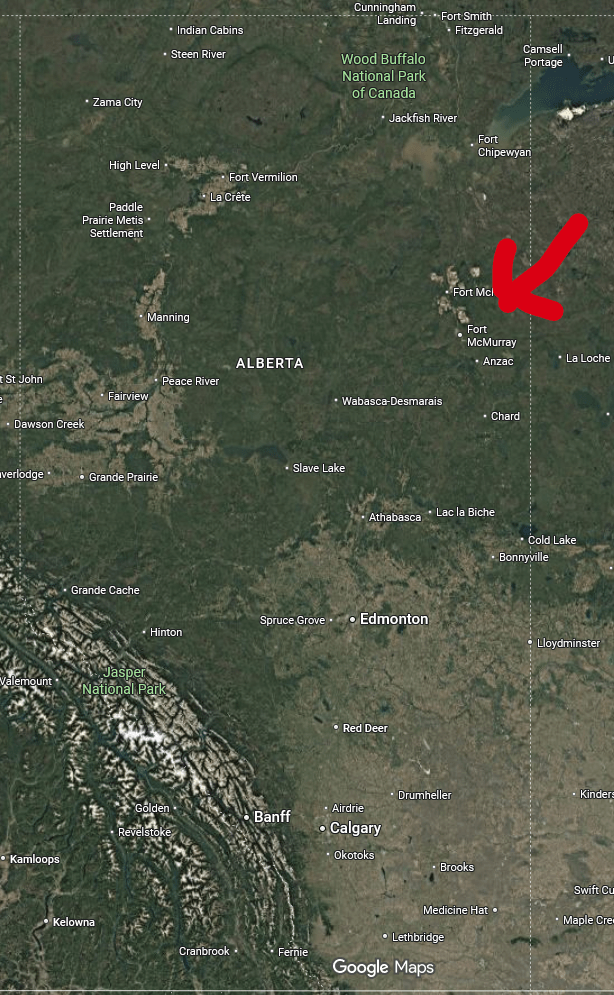
Seen from the perspective of Albertans, is oil industry financial’s more like a loan? E.g. money now, our kids and grandkids deal with the cleanup bill?
I hope not, there are some bright spots, its not all doom and gloom, Syncrude was recently asked to stomp up $1B cleanup bond, for their Mildred Lake-Aurora North mine (source). It is a start, and I think Albertans ought to do more of this, I think just about everyone wants those who pollute to pay for the cleanup.
If it will cost $72B to clean up just the tailing ponds (source), the aforementioned $9B a year Alberta collects in bitumen royalty is likely not enough money to fully fund the cleanup when the time comes. Everyone who lives downriver from Fort McMurry deserves access to clean water.
So far we have stayed mostly on water pollution. This ignores a huge problem with Albertan oil-sands, namely that Oil-sands CO2 emissions have trippled between 2005 and 2024 (source). Had that not happened, Canda’s overall emissions would have fallen by 20% since 2005, instead of staying relatively flat. So how do we value the impact of all that CO2? Climate change is certainly costing Canadians a lot of money, perhaps to the tune of 20-30 B$ a year by 2050 (source). That is to say nothing of other places, some have suggested that India might become uninhabitable in 2100 (source). Sure that last one might be far-fetched, but recent heat-waves have seen sustained temperatures of more than 40 C (source) in India.
Given all of this, I find it hard to justify investing in the oil-sands, while there is money, its not enough to fully fund and deal with the cleanup, even if we ingore the whole climate change thing, there is simply not enough money in it.


One thought on “The “Oil = Lots o jobs and Money” fallacy”