Diesel used to be cheaper than gas, but nowadays its usually quite a bit more expensive. Lets discuss how the Diesel price gap has evolved over time, and why that might be. Briefly, much has changed since the refineries serving the Toronto area were built. Instead of being all about gasoline, Jet-fuel and Diesel now compose a larger share of fuel sales than they used to.
Statistics Canada has a lovely database of many things, including for our purposes, retail prices for gasoline and diesel since the seventees. There are some data consistency things, but from 1990 to present, the data quality is quite good.
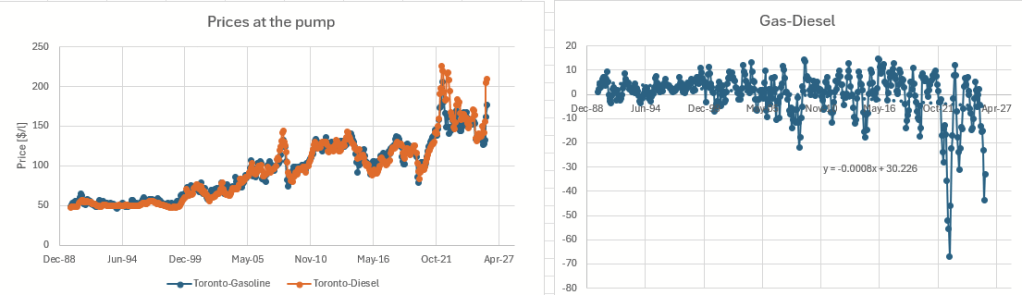
As we can see, back in the 1990’s, Diesel was generally cheaper than gas, by about 5 c/l, fast forward today nowadays Diesel is more like 20-30 c/l more expensive than gas. Some of that is undoubtedly due to electrification, hybrids/plug-in hybrids/battery electric vehicles are now at about a quarter of all new cars sold in Canada (source). These use a fraction (if any) of the gasoline, gas cars require. The same numbers do not appear in trucking, less than 1% of medium and heavy duty trucks on Canadian roads are electrified (source).
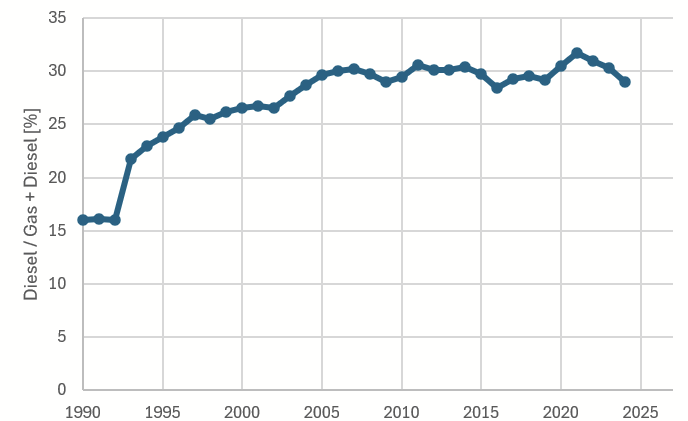
Diesel and gas are about 75% of refinery output, jet fuel adds another 10 % (source), but nevertheless it seems that electrification of road transport might be somewhat responsible for Diesel’s increased share over gasoline. Stats Canada does not track jet-fuel sales in the same way as Diesel and gas, but looking at the sales data, in 2012, Jet-fuel sales were about 6.5 Ml/year, growing to 8.5 Ml/year in 2024, compared to Diesel sales that were relatively flat at 17-18 Ml/year over the same time-period (source).
Refiners have some flexibility, for example recently Irving decided to bump the amount of Diesel they produce relative to Gasoline (source), as Mr. Trumps middle east adventures have upended oil markets, but as they tend to operate at very high utilisation rates, and the input fuel-mix has likely not changed all that much.
But the need for electrification in the heavy machinery is clear, strangely enough, as I walk my dog past the Ontario line construction site, I rarely see anything electric, and what machinery I do see looks like it was built in the last century. There is some evidence for this observation, as Canadian investment in machinery is at an all time low (source). But, higher Diesel prices surely improve the numbers, after all there are many innovations such as electronic fuel injection, computer based engine control and more that greatly improve fuel economy, and EV conversions.

