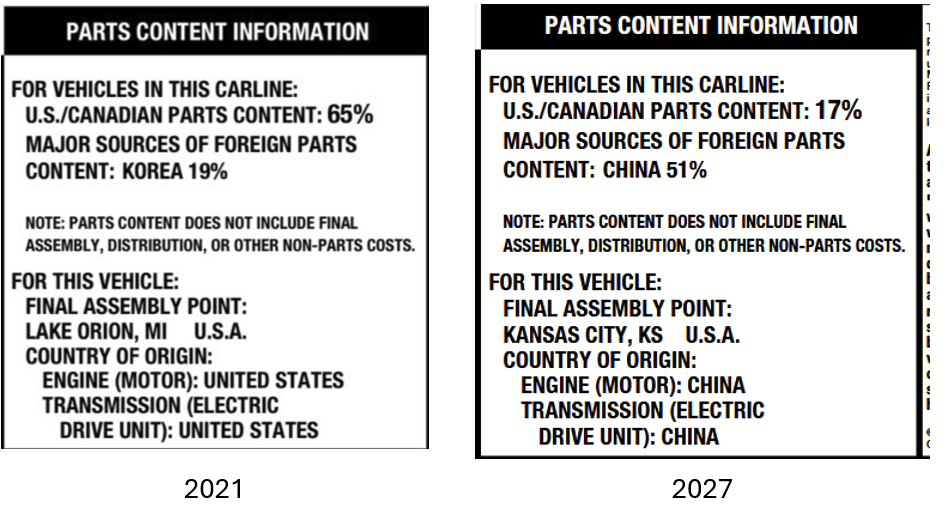
By all accounts Chevy has crafted a fine EV in the Chevy Bolt. It is the small EV that feels much larger on the inside, the main bugbear (slow fast charging speeds), has been resolved, and the new Bolt charges at a fairly competitive 150 kW giving it a 10-80% charge time of 25-30 minutes (source), I would have to do everything right to pee and chow down a burger in such a short time. But the Chinese part portion is a whopping 51% (source), a bit ironic given the 75% North America part count requirement in some free trade agreements (source), and the debate regarding eligibility of Chinese EV’s for the new EV affordability program, which the Chevy Bolt qualifies (source).
Labels these days contain much information, some redit users pointed out that the 2027 Chevy Bolt has much of its innards sourced from China. A whopping 51%, vs 65% of US/Canadian parts content for the outgoing 2023 model. What that means is that it seems much of the value of the part-chain is sourced from China, likely the entire drive-train looking at the hopefully accurate redit photos.
General Motors (GM), has had operations in China for decades, starting in 1997 (source). The goal was mostly to locally produce GM vehicles for sale in China, a rather successful business, until the 2020’s, when production started to stall as Chinese customers seemed to prefer something electric (source). GM is thus undoubtedly very familiar with the Chinese auto-industry and its capabilities, particularly when it comes to costs, something important when the sticker price is a rather impressive 35k CAD (source).
While the final assembly plant is still in North America, one has to wonder why a Chevy Bolt gets a the 5k, but a kit-build vehicle such as a Leapmotor produced in Brampton Ontario presumably would not (source).
To be fair, Leapmotor’s relationship with Stellantis is complicated, and Stellantis relationship with the Canadian government even more so. Stellantis took public money to re-tool the Bramton assembly line, only to change tack to please perhaps one Mr. Trump (source). Leapmotor might also be looking for a way into the North American market, and one has to wonder if GM has given it some ideas.
So, what would Leapmotor/Stellantis have to do to given us Canadians say a Brampton made B10 similar to the ones Irish customers enjoy, that would qualify for the 5k? At least in theory, they could ship the drive train (battery/motor/high voltage charge controllers e.t.c.), but would have to source other parts within North America, most notably software (source). It would nevertheless be a challenge to hit that 35k price point. Which might be OK as their first foray into North America.
But Stellantis apparently took 222 M from the federal government (source) which was supposed to ensure a steady stream of work for the Brampton Assembly plant, which has been idled since 2023, and was supposed to be operational this year. Anything but full resumption of work at the Brampton plant will be difficult for the federal government to accept, particularly as unemployment remains high, with many pointing the finger at American companies such as Stellantis (source).


One thought on “Is the new Chevy Bolt a ghost Chinese EV?”