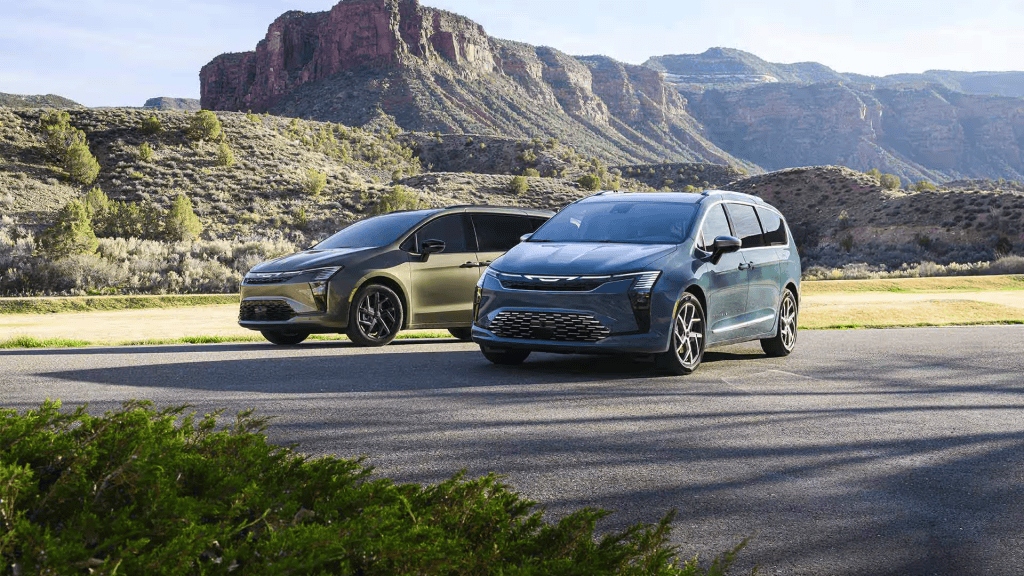
Once a back-bone of the Canadian auto-industry, the big three (GM, Ford and Stellantis) have been steadily reducing their Canadian manufacturing footprint for some time, Mr. Trump has in many ways accelerated their exit from the Canadian market, mostly to the benefit of Mexico. These days, with the exception of specialised trucks, the only vehicle from the big three assembled in Canada is the Chrysler Pacifica mini-van.
The Canada-US trade-war sure has heated up, with new Tariffs being levied faster than I can type (source, and source). Some say that the Trump administration is seeking to destroy the Canadian auto industry (source). Whatever the case, it seems the big three (GM, Ford and Stellantis) have very little in terms of vehicle assembly operations left in Canada.
Lets start with Ford, the only Canadian vehicle assembly plant is the Oakville assembly process (source), which as of this writing is assembling F-250/450 super duty trucks, which are often converted to specialised vehicles (source). GM seems on a similar track, with the only remaining assembly plant listed as producing specialised versions of the Chevy Silverado (source). Stellantis at least has a mass market vehicle (the Chrysler Pacifica mini-van) that is manufactured in Windsor, ON Canada (source), along with the Charger muscle car (source).
Much of this is owning to the Trump administrations tantrum on EVs, many of which were supposed to be manufactured in Canada (source, and source). Hence the big three would likely have had more vehicle assembly in Canada, and may still should a future US administration tone down the anti-EV rhetoric. Whatever the big three decide to do in the future, Chinese components might be used, for example the 2027 Chevy Bolt has a 51% Chinese major parts content (source), whatever that means. Canada’s China situation seems stable enough for Stellantis to propose building Chinese EV’s in Canada (source).
Whatever happens, all this seems to be accelerating a shift to Mexico, all underway well before Mr. Trump got into politics (source). It is really a shame that Mr. Trump chooses to attack the Canadian auto industry instead of finding ways to work together. Ontario and Michigan face many of the same problems, high wages and high unemployment. By working together surely we can come up with something more helpful than social media memes. The idea that destroying Canadian auto industry will save the American auto industry is just plain nonsense (source, source, source). I am not much of a business man, but I understand enough that pissing off your biggest customer is usually a bad idea.

