As the financial crisis hit back in 2008, there was lots of carnage. Banks went bust, mostly owning to poor decision making on mortgage loans, some of which were badly underwater. But auto-loans suffered to, and with it, the auto-makers (source). The US and Canada spent sizeable sums to prop up the big three (mostly GM, and what is now Stellantis). Now that the auto-bailout is approaching the age of maturity, lets discuss and review.
The reasoning for the auto-bailout mostly centred on preserving jobs, and in doing so, avoid a deeper recession. By large, these goals were met, and jobs were preserved (see chart below). But they were only preserved, as we can see in the chart below, job-creation in the industry, while it did happen, was somewhat disappointing, and did not reach pre-bailout levels.
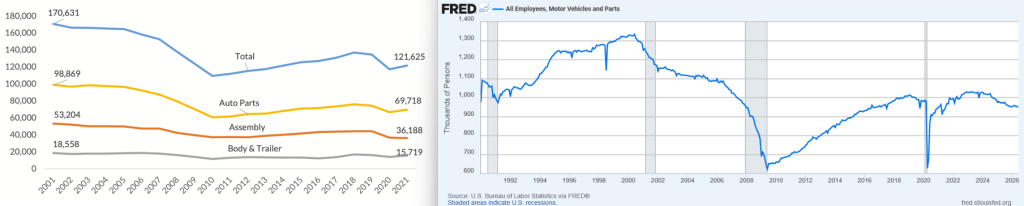
The cost was significant, the American and Canadian governments provided loans and other credit facilities of $80B and $14B respectively. Some of this was repaid, but taxpayers in the US and Canada were nevertheless on the hook for $17B and $4B respectively (source). Not entirely sure if these figures include interest expense, and if so, how close to market rates these loans and credit facilities were, hence the $21B if anything, is an under-estimate.
Then there are the secondary effects. These are much more difficult to analyze. On one hand, preserving the automakers (or really, slowing their decline), keeps lots of people employed, and dampens the effects of a recession, that is all true (source). On the other, you delay progress, automakers keep milking existing technology, poor industry practices continue, stagnation sets in (source).
And therein lies the rub, Tesla motors presented the Model-S to the world on the auto-show circuit back in 2009, yet production did not get underway until June 2012 (source). A GM sized hole in the US market would have sped things up considerably, no taxpayer money required. Surely the private sector would have seen this GM sized hole. Who knows, we might actually have a Canadian EV maker, say https://axlev.com/, or https://www.projectarrow.ca/ might have gotten to market.
Indeed, the Chinese only recently got in on the EV action. Build your dreams (BYD) for example only started producing in volume in the 2020’s (source). I might be stretching things a little, by stating that the auto-bailout delayed EV manufacturing in the US for at least a decade, and in doing so, opening the door to the Chinese. Surely the Chinese calculus would have been different had the Americans been producing EVs en masse.

