On a recent trip to the west coast, I needed to get from Victoria to Vancouver. I was surprised to learn that one of the cheaper way’s to get there was via sea-plane operator Harbour Air. Not to mention convenient, as I walked from my Victoria hotel, hopped on a sea-plane and walked from the Vancouver sea-plane terminal to my Vancouver hotel. Harbour air made some waves over their intention to go electric (source), chatting with the staff at the sea-plane terminal test-flights are still ongoing, somewhat tempered by the size and weight of the batteries, but lets explore what it might take for that electric flight to happen.
Harbor Air is a very unique airline. They operate a mixed fleet of De-Haviland Canada sea-planes: DHC-2 Beaver, DHC-3 Otter and the DHC-6 Twin Otter. These aircraft seat somewhere around 6, 14 and 20 passengers (source), and fly in and around the Vancouver area.
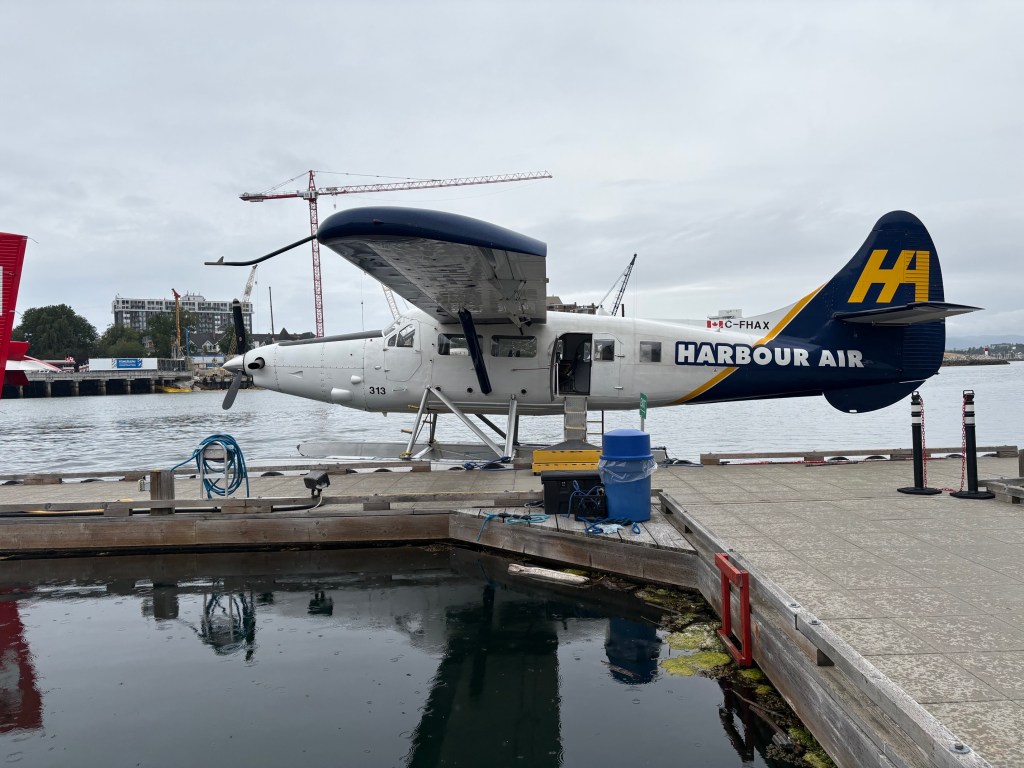
None of these flights are long, my 45 minute hop from Victoria to Vancouver was perhaps 100 km total, much of their route network would fit in that 100 km radius extending from the Vancouver Harbour. Had the cloud been a little higher, I suspect the pilot might have opted for a more direct route, of perhaps 30 minutes and 50 km.
The water solidifies that convenience downtown-to-downtown value proposition, either take a short sea-plane flight or you are looking at a ferry/car combo, or worse, a flight from a congested Vancouver international airport to Victoria airport (about 50 km north of Victoria itself).
As they sat me right behind the cockpit, I could of course not help myself but to record the fuel burn for our 45 minute flight, which was 303 lbs, or 137 kG which is 172 L. Factoring in Jet-1A’s thermal energy, our flight consumed perhaps 1.65 MWh (source). Typical Jet engines have a caloric efficiency of about 30%, hence in an electric drive-train, we would need at least a 500 kWh battery for the flight.
To cover contingencies (say bad weather or a diversion), we would need double that, since the flight was operated under visual flight rules (VFR), Canadian aviation regulations require a 45 minute reserve (source). Thus, we need to carry 1 MWh in our batteries for the flight. How heavy would a 1 MWh battery be?
For that we need to assume a battery specific energy, for Li-Ion, that is perhaps 400 Wh/Kg (source). Thus we can expect our 1MWh battery to weigh 2.5 t. Volume is less of a problem, with perhaps 800 Wh/l energy density achievable, giving our 1 MWh battery a volume of perhaps 1250 l (source), which is a little more than overall fuel capacity of the DHC-3 Otter at 800 or so l (source).
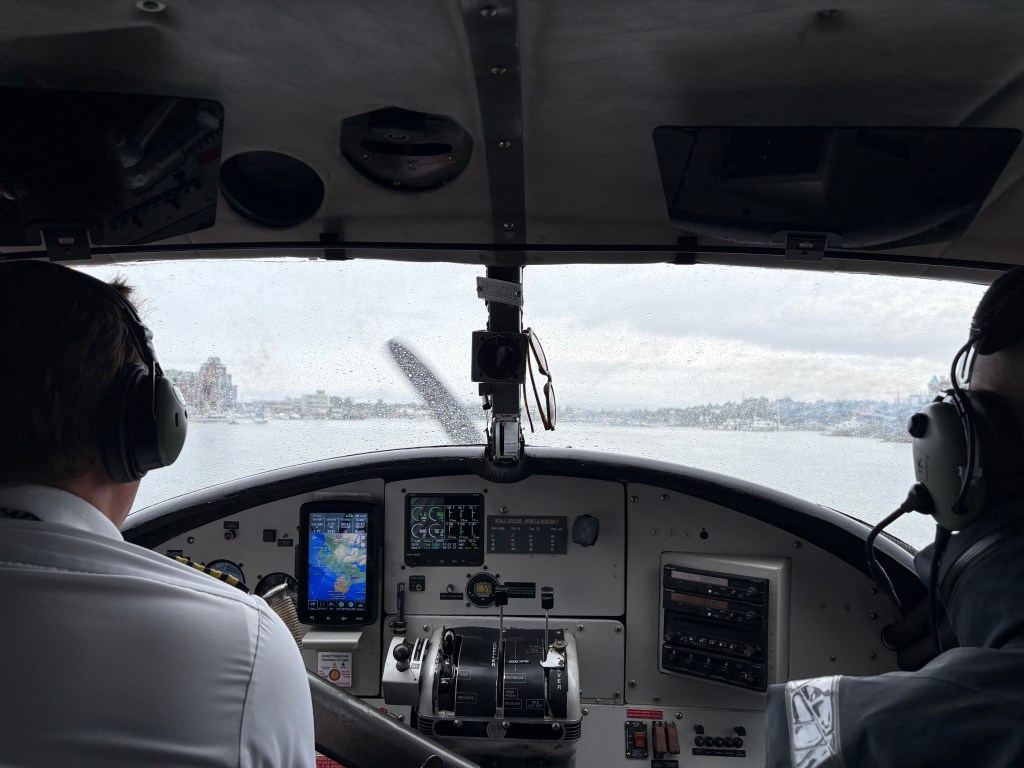
A large sign in the cockpit, which I happened to see, stated that the aircraft has a maximum take off weight (MTOW) of 9000 lbs, about 4t metric. About half of that is the aircraft operating empty weight (OEW, source). I.e. the air-plane, seats and all, but nothing onboard in terms of passengers, cargo, fuel, engine oil, coolant etc. If we assume that the jet-engine and the electric motor weight about the same, then stuff in the 2.5 t battery, roughly where the fuel tanks are, we wind up with a 4.5t aircraft, that is supposed to weigh 4t, a weight problem indeed.
The Otter was designed in the 50’s, long before carbon-fiber became a thing (source). Modern materials and methods can yield improvements on two fronts, first a bump in the 4t maximum take-off weight, and second a reduction in operating empty weight. The DHC-6 twin-otter got a modern refresh in 2010, where MTOW went up by 1t, and OEW went down by 100 kG (source). A similar effort of our e-Otter, battery and all, might yield an MTOW of 5t, and an OEW of 4.4t. I suspect we could do better, the floats for example could be carbon-fiber too. But these figures are in line with claimed payload figures for the Beta Ailia (source).
There is also the hybrid thing. The key reason our battery needs to be 1 MWh, is that 45 minute reserve, we would really only use half of it, so why not make the battery 500 kWh, and make up the difference with an onboard generator? The generator would hardly ever run, just when the weather turns unexpectedly bad. Assuming 300 kG for our emergency generator, fuel/oils and all, and using a 500 kWh pack for operations, our hybrid-Otter weight situation becomes MTOW of 5t, OEW of 3.5t, which is getting close to the original Otters, MTOW of 4t, and OEW of 2t.
In summary, Harbour Air, could use existing technology to electrify their operations, at least mostly. Current Li-Ion energy density is good enough to make this work. Harbour Air is a very unusual airline, but they have the grit to make it work, they do have a smaller e-Beaver flying out of their R&D facility, given time, I am sure they can find a way. I certainly would have appreciated that whisper quiet cruise of 58.9 dB, on the turbo version I flew, my phone recorded a far less pleasing 87 dB during cruise (source).

