One of the benefits of a rebate program such as the Canadian governments electric vehicle affordability program (EVAP), are the statistics it generates. Even better, the Canadian government has made these statistics publicly available (source). So, lets have a peak and see what Canadians are buying, or leasing for that matter.
While EVAP covers many EV’s, its far from all of them. Of note, the purchase price needs to be less than 50k Canadian, and the EV must be manufactured in a country with a free trade agreement with Canada. This will exclude many popular EVs such as the Tesla Model 3, the Kia EV9, and they Hyundai Ioniq 5. Also, EVAP is not just EV’s, it also includes some plug-in hybrids. Hence, my dear reader, add lots of salt.
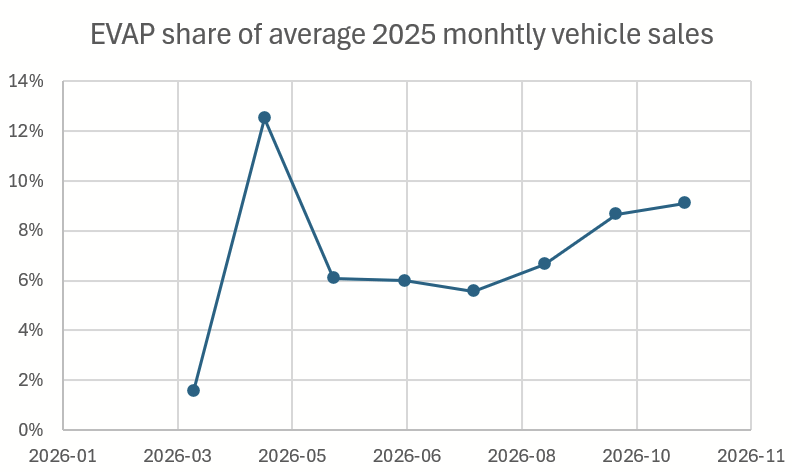
Starting with the EVAP sales share of all vehicle sales, using the EVAP numbers, as well as the 2025 sales total (source). EVAP sales indeed seem to be on a nice upward trajectory.
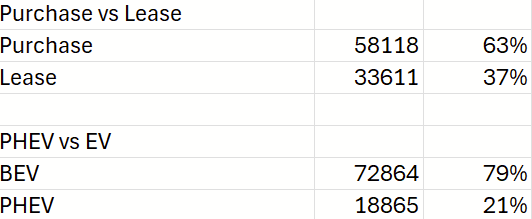
Looking further into the data shows us that most purchase their battery EVs. Interestingly the lease rate of EVAP’s seems a little higher than the industry standard figure of about 20-25% (source). Perhaps owning to concerns with depreciation might be driving that trend?
Some brands to seem more popular than others, quite a few Chevy Bolts and Equinox EV’s put Chevy in second place, behind auto giant Toyota with about a quarter of the total, driven by the Toyota Bz, Prius and RAV4 PHEVs.
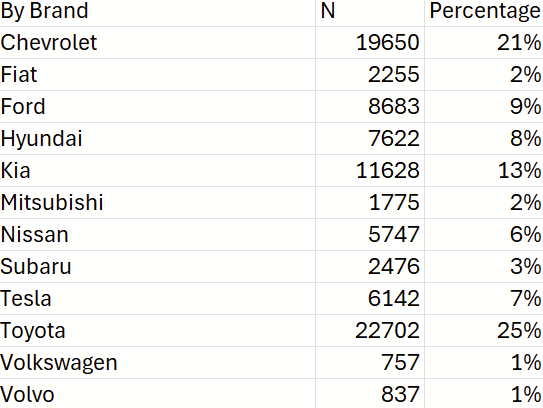
Of note, relatively few Tesla’s made it onto the list, mostly as the only EVAP eligible Tesla is a bare-bones version of the Tesla Y (source). If we were to include the Tesla Model 3 premium (built in China), Tesla’s figures might double (source).
Good to see EV market share climbing, EVAP alone seems to have bumped that figure up significantly, perhaps doubling the EV share of the Canadian auto-market.

